
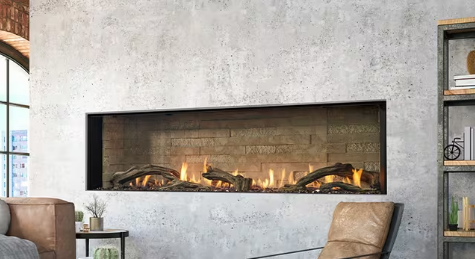
Tech Explained: Heat & Glo IntelliFire Touch Explained
How the Brains of a Modern Heat & Glo Gas Fireplace Actually Work—What ‘Intermittent Pilot Ignition’ Means and Why It Saves Gas, Cold Climate Mode, the Wall Switch, Touchscreen Remote, and App, Battery Backup for Outages, the Safety Features You Never See, and the One Limitation to Know About
Press a button, and a Heat & Glo® fireplace lights. That’s the whole experience most owners ever have with IntelliFire® Touch—and it’s designed that way. But behind that button is a small computer managing a spark, a pilot flame, a gas valve, a flame sensor, an oxygen sensor, a motor that sets the flame height, and, if you’ve added the Wi-Fi module, a connection to your phone and your smart speaker. Understanding what it’s doing explains a lot: why your gas bill is lower than your parents’ fireplace produced, why the glass stays clearer in winter if you flip one setting, why the fire still lights in a power outage, and why it shuts itself off after nine hours.
This is the Tech Explained version, drawn from Heat & Glo’s product literature and the IntelliFire Touch technical documentation. We’ll cover what intermittent pilot ignition is and why it replaced the standing pilot, Cold Climate mode, the hardware inside the fireplace, the three ways to control it and what each can do, the day-to-day features worth using, battery backup, the safety systems, the smart-home layer, and the honest limitations—including one that catches people off guard.
From Leisure Time Inc., an authorized Heat & Glo dealer with hearth showrooms in Boise, Idaho Falls, and Twin Falls. We install and service IntelliFire fireplaces every week, so this is the explainer we give owners at handoff.
The Short Version
- IntelliFire Touch is Heat & Glo’s most advanced intermittent-pilot ignition (IPI) system. The pilot lights only when you call for fire, instead of burning gas 24 hours a day like an old standing pilot.
- Cold Climate mode flips that—it keeps a small continuous pilot lit to keep the firebox warm and the glass clear of condensation in winter.
- You control it three ways: a wireless wall switch, a touchscreen remote, or the IntelliFire app (with an optional Wi-Fi module), plus Amazon Alexa and Google Assistant by voice.
- It runs on battery backup in an outage—the fire lights and burns; fans and lights don’t.
- Safety is built in: flame sensing, an oxygen depletion sensor, a child lock, and an automatic shutoff after nine hours of continuous operation.
- One limitation: if your installation uses a Power Vent, battery backup and Cold Climate mode are disabled.
First: What ‘Intermittent Pilot Ignition’ Means
For decades, gas fireplaces used a standing pilot: a small flame that burned continuously, around the clock, all year, so that it was always there to light the main burner. It was simple and it worked without electricity—but it burned gas every hour of every day, including all summer, and that adds up.
Intermittent pilot ignition changes the order of operations. The pilot stays off. When you ask for fire, an electronic control module sends a spark to light the pilot, a flame-sense electrode confirms the pilot is actually burning, and only then does the gas valve open to the main burner. When you turn the fire off, the pilot goes out too. Heat & Glo describes the benefit plainly: IPI lets you ‘conserve fuel and money when the fireplace is not in use.’ No gas is burned when you aren’t using the fireplace, which is most of the hours in a year.
| Characteristic | Standing Pilot | IntelliFire Touch (IPI) |
|---|---|---|
| Pilot flame | Burns continuously, 24/7 | Lights on demand, off when the fire is off |
| Gas use when idle | Constant | None (unless Cold Climate mode is on) |
| Ignition | Manual pilot lighting | Electronic spark, automatic |
| Flame proving | Thermocouple | Flame-sense electrode confirms pilot before the burner opens |
| Works in an outage? | Yes, inherently | Yes, via battery backup |
| Controls | Knob or basic switch | Wall switch, touchscreen remote, app, voice |
The Ignition Sequence, Step by Step
- You call for fire from the wall switch, remote, app, or voice assistant.
- The control module sparks the pilot. An igniter electrode fires a spark at the pilot assembly while the valve admits a small flow of pilot gas.
- The flame sensor proves the pilot. A sense electrode detects the pilot flame electrically. If it doesn’t sense flame within a set time, the system stops and retries rather than opening the main gas valve—this is the core safety logic.
- The main burner lights. With the pilot proven, the valve opens to the burner and the pilot ignites it.
- The flame height sets. A stepper motor on the valve adjusts the gas flow to your chosen level—most Heat & Glo models turn down to 50% of full input, some to 30%.
- You turn it off, and everything closes. Burner and pilot both go out. Nothing burns until you ask again.
Cold Climate Mode: When You Want the Pilot On
There’s one situation where a continuously burning pilot is actually what you want, and Heat & Glo built a switch for it. In cold weather, a direct-vent fireplace’s glass and firebox sit at outdoor temperatures between fires. Light a fire into a cold box and the warm combustion gases can fog the glass with condensation; a cold firebox also means a longer wait for radiant heat. Cold Climate mode turns on a small continuous pilot flame that, in Heat & Glo’s words, ‘reduces condensation on your fireplace glass’ and keeps the air in the firebox warm. The trade-off is that the pilot uses a little gas while it’s on—so the right rhythm for Idaho is simple: Cold Climate mode on from the first hard freeze through spring, off for the rest of the year. The wall switch and the remote both have a dedicated Cold Climate control.
The Hardware Behind the Button
Inside the fireplace, IntelliFire Touch is a small system of parts working together:
- Electronic Control Module (ECM): The brain. It sequences ignition, monitors the sensors, drives the flame-height motor, and talks to your controls. Heat & Glo’s current version is the ECM 2.0.
- IPI pilot assembly: The igniter electrode that sparks, the pilot burner, and the flame-sense electrode that proves the flame—all in one assembly.
- Gas valve with stepper motor: Supplies the pilot and regulates gas to the main burner. The stepper motor is what gives you adjustable flame height rather than just on/off.
- Oxygen depletion sensor (ODS): A safety sensor that shuts the fireplace down if the oxygen level in the pilot’s air supply drops below a safe threshold.
- Battery backup compartment: Holds the batteries that keep ignition working in a power outage.
- Wi-Fi module (optional): A 2.4 GHz module that connects the ECM to the IntelliFire app and to voice assistants.
Because the control module also knows whether your fireplace has a fan, accent lighting, or a power vent, the same remote or app shows you the controls that apply to your specific unit—which is why the feature lists below say ‘dependent on your fireplace.’
Three Ways to Control It
Heat & Glo offers three controllers, and you can mix them—a wall switch for the quick on/off plus a remote on the coffee table is a common setup. Here’s what each one does, per Heat & Glo’s specifications:
| Controller | Features | Best For |
|---|---|---|
| Wireless wall switch | On/off, battery strength indicator, Cold Climate mode | Everyday simplicity—flip it like a light switch, mounted where you walk in |
| Touchscreen remote | On/off, flame height adjustment, fan speed, accent-light adjustment, thermostat mode, room temperature readout, child lock, timer mode, battery backup indicator, Cold Climate mode, power vent control, and a wall docking station (fan, lights, and power vent depend on your fireplace) | Full control from the couch; the standard controller on most Heat & Glo models |
| IntelliFire app (with Wi-Fi module) | All the features of the remote on your phone, plus monitoring and control from anywhere, and voice control through Amazon Alexa and Google Assistant | Smart-home owners, and anyone who wants to warm the room before they get home |
The Features Worth Using Every Day
- Thermostat mode. The remote reads the room temperature and cycles the fire on and off to hold the temperature you set—turning the fireplace into a zone heater that runs itself rather than a fire you babysit.
- Timer mode. Set the fire to shut off after a chosen period—ideal for falling asleep in front of it.
- Flame height. Step the flame down for ambiance or up for heat; the stepper-motor valve makes this precise rather than a vague ‘low/high.’
- Fan speed and lighting. On fireplaces equipped with a blower or accent lighting, both are adjustable from the remote or app.
- Child lock. Locks the remote so small hands can’t light the fire.
- Memory settings. The system remembers your preferred flame height and settings between uses.
Battery Backup: Heat When the Power’s Out
Because IPI needs electricity to spark the pilot, an electronic-ignition fireplace could in theory go dark with the grid—and many competitors’ do. IntelliFire Touch includes a battery backup system inside the appliance that, in Heat & Glo’s words, offers a ‘seamless transition from AC to battery backup in a power outage.’ When the power fails, the control module switches to the batteries, and the fireplace continues to light and burn from the remote or wall switch. Fans and accent lighting won’t run, but the fire and its radiant heat will.
Two honest notes from the documentation. First, battery backup is for outages, ‘not to be used as a primary long-term power source’—a day or two of operation, not a season. Second, and this is the one that surprises people:
Some installations use a Power Vent—an electric fan in the vent run that lets the exhaust travel a longer or more complicated path than a standard direct vent can. It’s a great solution for tricky layouts, but it needs electricity to move the exhaust, so Heat & Glo disables both battery backup and Cold Climate mode when a Power Vent is installed. If outage heat matters to you—and in a mountain or rural Idaho home it should—tell us before we design the vent run. A standard direct-vent installation keeps the battery backup, and that’s the configuration we recommend wherever the layout allows.
The Safety You Never See
‘Simple, smart and safe’ is Heat & Glo’s summary of IntelliFire Touch, and the safety part is doing a lot of quiet work:
- Flame proving. The main gas valve never opens until the sense electrode confirms a pilot flame. No pilot, no gas.
- Oxygen depletion sensor. Shuts the unit down if oxygen in the pilot’s air supply drops too low.
- Nine-hour automatic shutoff. The appliance ‘automatically shuts down after 9 hours of continuous operation’ without a command from any paired control—so a fireplace left on by accident doesn’t burn all night and all day.
- Child lock on the remote.
- Sealed combustion. Not an IntelliFire feature strictly, but worth saying: the direct-vent fireplaces IntelliFire controls draw air from outside and exhaust outside, keeping 100% of combustion byproducts out of the room. Pair it with working carbon monoxide detectors, as with any fuel-burning appliance.
The Smart-Home Layer
Add the optional IntelliFire Wi-Fi module and the fireplace joins your network on 2.4 GHz. The IntelliFire app then gives you every remote function on your phone—and the two things a remote can’t: control and monitoring from anywhere, and voice. Heat & Glo lists compatibility with Amazon Alexa and Google Assistant, so ‘turn on the fireplace’ works the way it should. Practical uses our customers mention most: lighting the fire from the car on the way home, checking from the office that it’s off, and setting the thermostat mode from bed. Setup is through the app; Heat & Glo publishes setup and smart-home syncing videos, and we walk through it at installation.
Which Fireplaces Have IntelliFire Touch
IntelliFire Touch is the standard ignition system across Heat & Glo’s current direct-vent gas lineup—including the Mezzo and Primo linears, the Cosmo, the SlimLine, the 6000 and 8000 Series, and Heat & Glo’s gas inserts—with the touchscreen remote typically standard and the wall switch and Wi-Fi module as options. Because Heat & Glo is part of Hearth & Home Technologies, the same system also runs the gas fireplaces from its sister brands Heatilator, Quadra-Fire, and Majestic, so a Heatilator Crave or a Quadra-Fire Pioneer uses the identical controls. If you’re comparing across those brands, the ignition and app experience won’t be a differentiator; the firebox, flame, and finish will.
Troubleshooting Quick Hits
- Remote stopped responding: Replace its batteries first; then check the wall switch’s battery indicator. Most ‘dead fireplace’ calls are dead controller batteries.
- Fire won’t light during an outage: Check the batteries in the appliance’s backup compartment (not the remote). If you have a Power Vent, backup isn’t available—see above.
- Glass fogs at start-up in winter: Turn on Cold Climate mode. The fog usually clears as the glass warms, but the continuous pilot prevents it.
- Fire shut off on its own: If it’s been burning nine hours, that’s the automatic shutoff working. Just turn it back on.
- App won’t connect: The Wi-Fi module uses 2.4 GHz only; make sure your phone is on that band during setup. Holding the pilot button for ten seconds resets the module.
- Pilot sparks but won’t stay lit: Time for service—typically a sensor or pilot assembly cleaning. Annual service keeps the electrodes clean and the system reliable.
Frequently Asked Questions
What is IntelliFire Touch?
It’s Heat & Glo’s most advanced intermittent-pilot ignition (IPI) system—the electronic brain that lights and controls the fireplace. Instead of a pilot that burns constantly, IntelliFire Touch sparks the pilot only when you call for fire, confirms it with a flame sensor, then opens the main burner. You operate it from a wireless wall switch, a touchscreen remote, or the IntelliFire app, and it includes battery backup and built-in safety features.
Does intermittent pilot ignition really save gas?
Yes. A standing pilot burns gas every hour of every day, including all summer. With IPI, no gas burns while the fireplace is off, which is most of the year. Heat & Glo says IPI lets you ‘conserve fuel and money when the fireplace is not in use.’ Cold Climate mode keeps a small pilot lit in winter by choice; turn it off in warm months to get the full savings.
What does Cold Climate mode do?
It turns on a small continuous pilot flame so the firebox stays warm and the glass stays clear of condensation between fires—a real issue when a direct-vent fireplace sits at outdoor temperatures in an Idaho winter. It uses a little gas while on, so the usual rhythm is on from the first hard freeze through spring and off the rest of the year. Both the wall switch and the remote have a Cold Climate control.
Will my Heat & Glo work in a power outage?
Yes, on standard direct-vent installations: IntelliFire Touch includes a battery backup that takes over seamlessly, so the fire lights and burns from the remote or wall switch (fans and lights won’t run). It’s for outages, not long-term use. The exception is installations with a Power Vent, where battery backup and Cold Climate mode are disabled—tell us if outage heat matters so we design the vent accordingly.
Can I control it with my phone or Alexa?
Yes, with the optional IntelliFire Wi-Fi module. The IntelliFire app gives you every remote function on your phone plus control and monitoring from anywhere, and it works with Amazon Alexa and Google Assistant for voice control. The module connects on 2.4 GHz Wi-Fi; Heat & Glo provides setup videos, and we help at installation.
Why did my fireplace turn off by itself?
Most likely the nine-hour safety shutoff: IntelliFire Touch automatically shuts the fireplace down after nine hours of continuous operation without a command from a paired control, so a fire left on by accident doesn’t burn indefinitely. Just turn it back on. If it shuts off much sooner, check the controller batteries first, then call us for service.
At Leisure Time Inc., the IntelliFire walkthrough is part of every Heat & Glo installation: we pair the controls, set up the app if you want it, show you Cold Climate mode and thermostat mode, and—most importantly for an Idaho winter—make sure the vent design preserves your battery backup. If you already own a Heat & Glo and have never touched the remote beyond on/off, bring it in or call; the features you’re not using are the ones that make the fireplace a heater you can rely on.
A spark only when you ask, a pilot only when it’s cold, and a fire that lights with the power out—that’s IntelliFire Touch, explained.
Heat & Glo Mezzo Deep Dive: leisuretimeinc.com/blogs/fireplaces-stoves/heat-glo-mezzo-review-linear-gas-fireplace
Shop Heat & Glo: leisuretimeinc.com/collections/heat-glo
Browse Fireplaces & Stoves: leisuretimeinc.com/collections/fireplaces-stoves
Choosing the Right Fireplace for a Mountain Home: leisuretimeinc.com/blogs/fireplaces-stoves/choosing-the-right-fireplace-for-a-mountain-home
Preparedness Without the Panic: leisuretimeinc.com/blogs/fireplaces-stoves/preparedness-without-the-panic-heat-food-water-comfort-when-the-power-goes-out
Idaho Fireplace Permit & Code Guide: leisuretimeinc.com/blogs/fireplaces-stoves/idaho-fireplace-permit-code-guide
Locations: leisuretimeinc.com/pages/store-locations
Boise: (208) 376-0180 • Idaho Falls: (208) 523-4633 • Twin Falls: (208) 933-4295