
Wildfire Smoke Season and Your Hot Tub: Keeping Water Clear When Idaho's Air Turns Orange
The Idaho Smoke-Season Playbook—What Ash and Smoke Actually Do to Spa Water, the Before-During-After Routine That Keeps It Clear, Why Your Filters Are the Front Line, the pH and Chlorine-Demand Chemistry, Cover Care, When It’s Safe to Soak, and What to Do With a Spa If the Fire Gets Close
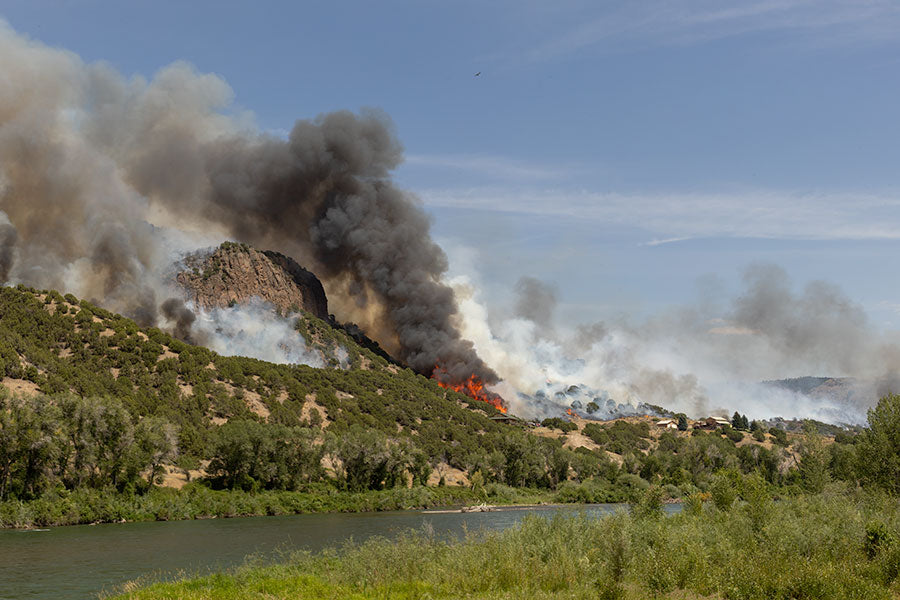
Every Idahoan knows the look: a sun that rises red, a sky the color of weak tea, a thin film of gray on the patio furniture by evening. Smoke season has become a fixture of Idaho summers, drifting in from fires across the West from July into September, and while most of us think about it in terms of air quality and canceled hikes, it has a quieter effect in the backyard. The same ash and smoke that settle on your car settle on your hot tub cover—and get into the water every time you open it.
This is the smoke-season playbook for a spa. We’ll explain what’s actually in wildfire smoke and ash and what each component does to spa water (it raises pH, feeds chlorine demand, and clogs filters—three different problems with three different fixes), lay out a before-during-after routine, cover filter and cover care, address the question everyone asks about whether it’s safe to soak when the AQI is bad, and finish with what to do with a spa if a fire gets close. The chemistry is grounded in the same FreshWater® water-care targets we use all year; smoke season just stresses them.
From Leisure Time Inc., with showrooms in Boise, Idaho Falls, and Twin Falls. We field a wave of ‘my water went cloudy’ calls every August, and nearly all of them trace to the sky.
The Short Version
- Ash does three things to spa water: raises pH and alkalinity (it’s alkaline), adds phosphates and organics that burn through chlorine, and clouds the water with fine particulate that loads your filters.
- Filters are the front line. Rinse them weekly during smoke, rotate a spare set, and deep-clean or replace at season’s end.
- Test more often. Every few days in heavy smoke—pH will drift up, chlorine will drift down, and FreshWater IQ will show you both.
- Use Boost, not more granules. The FreshWater Salt System’s Boost mode handles the extra chlorine demand without the cyanuric acid buildup of repeated dichlor.
- Keep the cover closed and rinse it, don’t scrub it. Ash is abrasive.
- Check the AQI before you soak, keep sessions short on bad days, and skip it when the air is in the red.
What’s Actually in Smoke and Ash—and What It Does to Water
Wildfire smoke isn’t one thing. It’s a mix of fine particulate, wood ash, and the gases and compounds released when forests burn, and each part affects spa water differently:
| What Lands in the Water | What It Does | What You Do |
|---|---|---|
| Wood ash (alkaline minerals) | Raises pH and total alkalinity. In hard-water areas, high pH is what makes calcium scale, so smoke season compounds Idaho’s hardness problem | Test pH every few days; keep pH Down on hand; hold alkalinity in the 40–120 range and pH at 7.2–7.8 |
| Phosphates and nutrients | Ash carries phosphorus and nitrogen that feed bacteria and algae, raising chlorine demand so the water won’t hold a residual | Test phosphates after a heavy smoke event; treat minimally to under 300 ppb if high; run Boost |
| Organic carbon and soot | Reacts with chlorine to form chloramines—the ‘chlorine smell’ and eye sting—while using up free chlorine | Shock after a heavy event; keep the salt system generating; rinse filters |
| Fine particulate | Clouds the water, settles as a gray film on the shell, and loads filters fast; can cause foaming with oils | Rinse filters weekly or more; wipe the waterline; keep the cover closed |
| Dust carried on the same wind | More particulate and more hardness | Same as above—filters and cover |
The practical upshot: smoke season doesn’t break any rule of water care. It just pushes pH up, chlorine down, and filter loading way up, all at once—so the routine that works is the normal routine, run more often.
The Smoke-Season Routine: Before, During, After
Before the Smoke Arrives (Late June–Early July)
- Start the season with clean filters. Deep-clean your filters—or install a fresh set—so they have full capacity when the loading starts. Our filter collection has every Hot Spring and Caldera size.
- Buy a spare set. Rotating two sets of filters—one in the spa, one drying after a clean—is the single best smoke-season move.
- Balance the water and test phosphates. Go into the season with pH at 7.4, alkalinity near 80, hardness at 50, and phosphates low, so you have margin.
- Inspect the cover. A cover that seals tight keeps ash out; one that sags or gaps lets it in. If it’s heavy and waterlogged, replace it before the season—see our cover guide.
- Stock up. pH Down, a start-up or shock product, phosphate test strips, and FreshWater 5-Way strips. Put them on Autoship and they’re there before you need them.
During Heavy Smoke
- Keep the cover closed except when you’re in the spa. Every open hour is an hour of ash landing on the water.
- Test every two to three days. Chlorine, pH, and alkalinity with a 5-Way strip; or let FreshWater IQ’s hourly readings do it, and watch for the pH bar climbing and the chlorine bar dropping.
- Run Boost after heavy use or a heavy smoke day. The FreshWater Salt System’s Boost mode runs the cartridge at full output for 24 hours—the right tool for a temporary spike in chlorine demand. If your normal Output Level can’t hold 1–5 ppm during the season, step it up one and bring it back down in September.
- Rinse the filters weekly—more if the water clouds. Swap in the spare set and let the rinsed set dry.
- Shock after a bad event. A day of thick smoke, or a soak with a lot of people, calls for a shock to burn off organics and chloramines. Use liquid chlorine or plain bleach rather than repeated dichlor to avoid cyanuric acid buildup.
- Wipe the waterline and shell. A damp cloth at each filter rinse keeps the gray film from setting into scale.
After the Season (Late September)
- Deep-clean or replace the filters. A season of ash shortens a cartridge’s life; if a deep clean doesn’t restore flow, replace it.
- Test phosphates and hardness. Treat phosphates if they’re over 300 ppb; bring hardness back to 50 if ash and dust pushed it up.
- Consider a drain and refill if the water has gone through a heavy season—high dissolved solids, persistent cloudiness, or a sour smell are the signs. It’s a good time anyway: fall is the easiest season to refill before winter.
- Rinse the cover and the cabinet to clear the summer’s ash before it sits under snow.
- Reset the Output Level to its normal setting.
The instinct when chlorine drops is to pour in more granules. In a FreshWater Salt System spa, that’s the wrong tool: repeated dichlor adds cyanuric acid that eventually locks up your chlorine and forces a drain. The right tool is Boost—24 hours of maximum generation with no stabilizer—or, if you must shock by hand, liquid chlorine or plain bleach. Smoke season is exactly what Boost was designed for.
Filters: The Front Line
Ash is fine particulate, and fine particulate is what filters are for. Hot Spring and Caldera spas run 100% no-bypass filtration—every gallon passes through the filters before it returns to the spa—which is why they clear smoke-season water so well if the filters have capacity. A loaded filter restricts flow, strains the pump, and lets the water cloud. The routine:
- Weekly rinse with a hose during smoke; use a filter-cleaning nozzle to get between the pleats.
- Rotate a spare set. Pull the dirty set, drop in the clean one, rinse the dirty set and let it dry fully before it goes back. Dry time matters—it kills what water can’t.
- Monthly deep clean with a filter-cleaning soak, which dissolves the oils that bind ash to the pleats.
- Replace at season’s end if flow doesn’t recover. Tri-X® ceramic filters on Hot Spring spas can go in the dishwasher (no detergent) for a deep clean; pleated cartridges soak.
- Watch the circulation. Weak flow at the filter compartment return is the earliest sign the filters need attention—and on a FreshWater IQ spa, weak flow also means unreliable sensor readings.
pH, Alkalinity, and the Hard-Water Multiplier
Wood ash is alkaline—it’s the reason ash was used to make lye—so even a modest amount of fallout pushes spa pH and alkalinity upward over a week of smoke. That matters doubly in Idaho, where most of our water is hard: high pH is what makes dissolved calcium drop out as scale, so a smoky August can scale a heater and a salt cartridge faster than any other month. The fix is vigilance and pH Down. Test every few days, bring pH back into 7.2–7.8 as soon as it climbs, keep alkalinity in the 40–120 range so pH stays put, and hold hardness at the 50 ppm target. If your fill water runs hard, our regional hardness guide explains why this season is the one to stay on top of it.
Cloudy or Foamy Water: What to Do (and What Not To)
Cloudy water during smoke is almost always particulate plus a filter that’s behind. Foam is particulate plus oils—sunscreen, lotion, sweat—whipped by the jets. The fix for both is the same, and it isn’t a bottle:
- Rinse or swap the filters first. Nine times out of ten, this clears cloudiness within a day.
- Check chlorine and pH. Low chlorine lets organics accumulate; high pH clouds water on its own. Correct both.
- Shock if the water smells or the chlorine reading is near zero.
- Rinse off before you get in during smoke season—it cuts the oils that make foam.
- Be careful with clarifiers. Aluminum-based clarifiers and multi-function ‘water conditioner’ products can leave residuals that foul a FreshWater IQ sensor. If filters, balance, and a shock don’t clear the water in a couple of days, bring us a sample before reaching for a clarifier.
Cover Care: Rinse, Don’t Scrub
Your cover takes the brunt of the season, and ash is abrasive. Hose the cover off every few days during heavy smoke rather than wiping it dry—dry-wiping grinds ash into the vinyl. Use a vinyl cleaner and conditioner at season’s end. Keep the cover locked when the spa is idle so ash can’t blow under the edges, and if you have a cover lifter, open it only as far as needed to get in. A cover that stays clean and sealed through August is a cover that lasts through the winters that follow.
Is It Safe to Soak When the Air Is Orange?
Honest answer: the water isn’t the issue; the air is. A hot tub doesn’t filter the air you breathe, and the warm, humid plume above the spa doesn’t clean it either. Soaking is low exertion, so it’s gentler than a run, but twenty minutes outside in unhealthy air is still twenty minutes of exposure. A few practical guidelines:
- Check the Air Quality Index before you go out. When the AQI is in the orange (unhealthy for sensitive groups), keep soaks short and skip them if you have asthma, heart or lung conditions, are pregnant, or are soaking with young children or older adults. When it’s red or worse, wait for a clearer day.
- Pick your hour. Smoke often settles into Idaho’s valleys overnight and lifts somewhat by afternoon; the AQI tells you when your window is.
- Keep sessions brief and get out if your eyes or throat start to burn.
- Rinse before and after. It keeps ash and oils out of the water and off your skin.
If you’re in an evacuation zone, close and lock the cover, leave the spa full and powered if it’s safe to do so, and go. A full spa holds 350 to 450 gallons of water that fire crews can and do draw from to protect a home, and it’s far safer than a drained spa with water in the lines. Don’t drain it to ‘protect’ it. If embers are a concern, a spa out in the open on a concrete pad is about as fire-resistant as anything in a backyard; keep woodpiles and brush away from it as part of your defensible space. Our preparedness guide covers the spa as an emergency water reserve.
Frequently Asked Questions
Why did my hot tub water go cloudy during smoke season?
Fine ash and particulate falling into the water and loading your filters faster than they can clear it—usually combined with chlorine that’s been used up by the organics in smoke and a pH that’s drifted high. Rinse or swap the filters, correct pH and chlorine, shock if needed, and keep the cover closed. The water typically clears within a day or two.
Does wildfire smoke change my hot tub’s pH?
Yes. Wood ash is alkaline, so ash fallout raises pH and total alkalinity over a smoky week. In Idaho’s hard water, high pH is what makes calcium scale, so test every few days during smoke, use pH Down as soon as pH climbs above 7.8, and keep alkalinity in the 40–120 range so pH stays put.
How often should I clean my filters during smoke season?
Rinse weekly at minimum, more if the water clouds, and rotate a spare set so a clean, fully dried set is always ready. Deep-clean monthly with a filter soak to dissolve the oils that bind ash to the pleats, and replace at season’s end if flow doesn’t recover. Hot Spring and Caldera spas filter 100% of the water with no bypass, so filter capacity is the whole game.
Should I add extra chlorine when it’s smoky?
Use the FreshWater Salt System’s Boost mode after a heavy smoke day or a busy soak—24 hours of maximum generation with no stabilizer. If your normal Output Level can’t hold 1–5 ppm through the season, raise it one step and lower it in September. Avoid repeated dichlor granules, which add cyanuric acid and eventually lock up your chlorine; if you shock by hand, use liquid chlorine or plain bleach.
Is it safe to use a hot tub when the air quality is bad?
The water is fine; the air is the concern, and a spa doesn’t filter it. Check the AQI first. When it’s orange, keep soaks short and skip them if you or anyone with you has asthma, heart or lung conditions, is pregnant, is very young, or is older. When it’s red or worse, wait for a clearer day. Smoke often lifts somewhat by afternoon; the AQI shows your window.
Should I drain my hot tub after smoke season?
Not automatically—a FreshWater Salt System spa with clean filters and balanced water can carry on. But if the water stayed cloudy, smells sour, or tests high in dissolved solids after a heavy season, fall is the ideal time to drain and refill before winter. Test phosphates and hardness either way and bring both back to target.
Smoke season is a fact of Idaho summers now, and a hot tub handles it fine with a little attention: clean filters going in, a spare set to rotate, pH Down on the shelf, Boost instead of a bucket, and a cover that stays closed and rinsed. Watch the AQI for yourself, leave the spa full if the fire gets close, and retest in September. The water will be clear by the time the sky is.
Filters, pH, Boost, cover—four habits, run a little more often, and smoke season never reaches the water.
Spa Filters: leisuretimeinc.com/collections/spa-filters
Spa Water Care Collection: leisuretimeinc.com/collections/spa-water-care
FreshWater Products: leisuretimeinc.com/collections/freshwater
Autoship: leisuretimeinc.com/collections/autoship
Water Care Guides: leisuretimeinc.com/pages/water-care-guides
How to Choose a Hot Tub Cover: leisuretimeinc.com/blogs/spas-pools/how-to-choose-a-hot-tub-cover
Hard Water by Idaho Region: leisuretimeinc.com/blogs/spas-pools/hard-water-by-idaho-region-boise-idaho-falls-twin-falls-fill-water-spa
Idaho Well Water and Your Hot Tub: leisuretimeinc.com/blogs/spas-pools/idaho-well-water-and-your-hot-tub-testing-metals-hardness-phosphates-before-you-fill
Tech Explained: The FreshWater Salt System: leisuretimeinc.com/blogs/spas-pools/tech-explained-freshwater-salt-system
Tech Explained: FreshWater IQ: leisuretimeinc.com/blogs/spas-pools/tech-explained-freshwater-iq-automated-water-monitoring
Preparedness Without the Panic: leisuretimeinc.com/blogs/fireplaces-stoves/preparedness-without-the-panic-heat-food-water-comfort-when-the-power-goes-out
FreshWater Salt System (Hot Spring): hotspring.com/shop/water-care/freshwater-salt-system
Store Locations: leisuretimeinc.com/pages/store-locations
Boise: (208) 376-0180 • Idaho Falls: (208) 523-4633 • Twin Falls: (208) 933-4295