
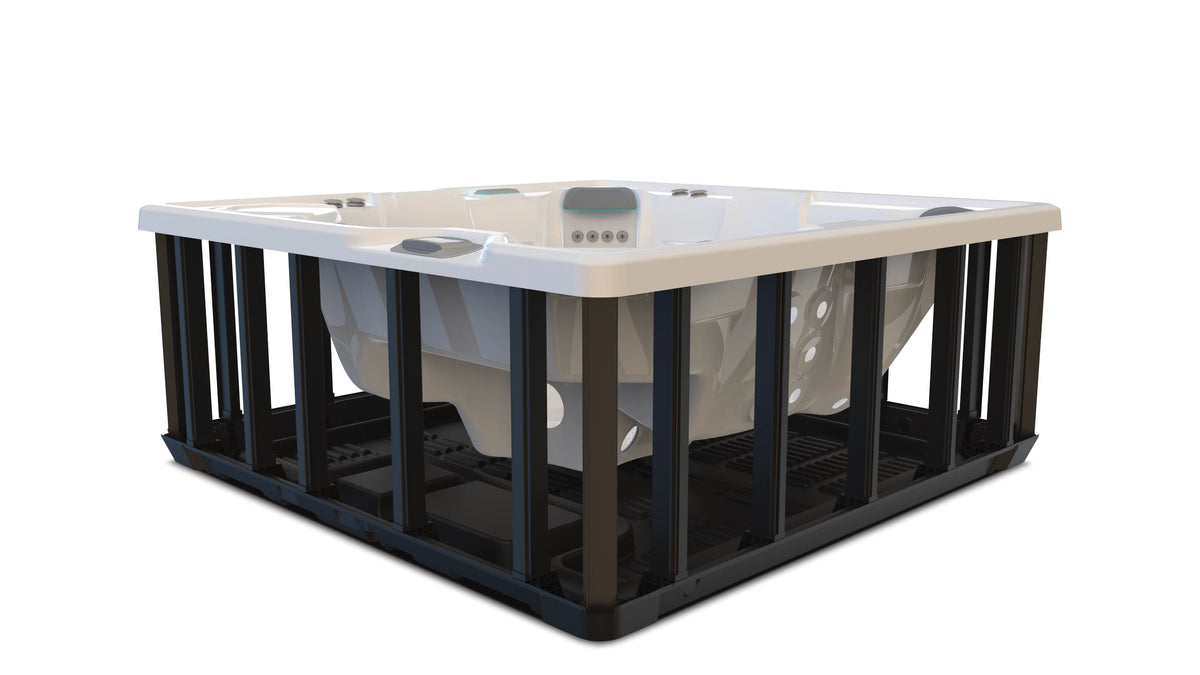
Tech Explained: Full-Foam vs. FiberCor vs. SunStrong — Insulation Systems Compared
How the Spas We Sell Hold Their Heat—Hot Spring’s Multi-Density Full Foam, Watkins’ Wool-Like FiberCor, Sundance’s Full Foam Inside the SunStrong Frame, the Rest of the Thermal Envelope, and What It All Means in an Idaho Winter
Nobody buys a hot tub for the insulation. But in a climate like ours, insulation is quietly the biggest factor in what the spa costs to run every month and whether it survives a January power outage. It’s also something you can’t see, which makes it easy for marketing to blur. ‘Full foam,’ ‘FiberCor,’ ‘SunStrong’—the brands we carry each lead with a different name, and shoppers understandably want to know which one is best.
This is the Tech Explained version. We’ll start with a clarification the industry rarely makes (one of those three names isn’t an insulation at all), explain where a hot tub actually loses heat, walk through each manufacturer’s approach using their own technical documentation, put them side by side, cover the rest of the ‘thermal envelope’ that matters as much as the cabinet fill, and then get practical about what it all means for a spa sitting on a patio in Boise or Driggs in February.
From Leisure Time Inc., the authorized Hot Spring, Caldera, and Sundance dealer for southern Idaho, with showrooms in Boise, Idaho Falls, and Twin Falls. We sell all three systems, so we have no reason to favor one beyond what works for you.
The Short Version
- Two of these are insulation materials; one is a frame. Full foam and FiberCor are what fills the cabinet. SunStrong is Sundance’s structural frame-and-cabinet system—Sundance’s actual insulation is full foam.
- All three brands fill the entire cabinet cavity. That ‘full-cavity’ approach is the one thing Hot Spring, Caldera, and Sundance all agree on, and it’s the biggest single driver of efficiency in a cold climate.
- Hot Spring Highlife uses the most elaborate version: multi-density full foam, with six different foam densities layered through the spa.
- FiberCor trades foam for a dense, wool-like fiber with the same insulating value, that can’t mold and—unlike foam—can be moved aside for service.
- Sundance pairs full foam with the SunStrong frame and offers an optional cold-weather package that adds an EcoWrap insulation layer and an upgraded cover.
- Every spa we sell in all three brands is certified to California Energy Commission standards—the strictest efficiency test in the industry—so you’re choosing between good options, not good and bad.
First, a Clarification: Two Insulations and One Frame
The comparison in this post’s title is how customers ask the question, so it’s worth answering honestly before going further. Full foam and FiberCor® are insulation materials—what fills the space between the spa shell and the cabinet walls. SunStrong® is something different: it’s Sundance’s name for the spa’s structural system—a steel frame on the 880 Series, a hybrid frame with a dual-insulated cabinet on the 980, and the UV-resistant synthetic cabinetry (the ‘SunStrong skirt’) that encloses it. It’s the box; the insulation goes inside the box.
So what insulates a Sundance? Full foam. Sundance’s own energy-efficiency page describes ‘full-foam construction’ with ‘strategic insulation throughout the cabinet,’ and its cold-climate page says its spas are ‘built with high-quality, full-foam insulation’ around the shell and plumbing. That means the real comparison is between two insulation philosophies—foam versus fiber—plus how each brand builds the frame, base, cover, and equipment that complete the thermal envelope. That’s a more useful comparison anyway, because it’s the whole system that keeps your water hot, not the fill alone.
Where a Hot Tub Actually Loses Heat
To judge insulation, it helps to know what it’s fighting. A spa holding 400 gallons at 102°F in freezing air loses heat through four paths:
- The water surface and cover. The single largest path, by a wide margin—which is why we tell every customer the cover matters as much as anything inside the cabinet.
- The shell and cabinet walls. Heat conducts out through the acrylic shell and the air space behind it. This is what cabinet insulation addresses.
- The plumbing. Dozens of feet of pipe carry hot water through the cabinet. If that plumbing sits in open air inside the cabinet, it radiates heat constantly. If it’s buried in insulation, it doesn’t—and it’s protected from freezing.
- The base. Heat conducts down into a cold concrete pad or frozen ground unless the base is insulated or isolated.
Keep those four paths in mind, because the biggest industry debate—full-cavity versus perimeter insulation—is really an argument about the third one.
Some brands insulate only the cabinet walls (‘perimeter’ or ‘thermal shield’ insulation), leaving the plumbing in an open, heated air space. The argument is serviceability and capturing pump heat. Hot Spring, Caldera, and Sundance all take the other side: fill the entire cavity so the plumbing is insulated too. Hot Spring’s own guide states full foam uses half or less the energy of a partial-foam spa, and Sundance’s cold-climate guidance says full-foam systems perform significantly better than perimeter systems in cold climates. For an Idaho winter, that’s the consensus we’ve seen hold up in our customers’ power bills.
The Three Approaches
1. Multi-Density Full Foam — Hot Spring Highlife®
Full foam means polyurethane foam sprayed in to fill the whole cavity between shell and cabinet, surrounding the plumbing and eliminating the air movement that carries heat away. It also stiffens the plumbing and reduces vibration. Early full-foam spas used a single density of foam, which runs into a limit: very dense foam can’t be used throughout because of how it expands.
Hot Spring’s answer in the Highlife Collection is multi-density full foam. Per Hot Spring, Highlife spas are sprayed with two different foam densities on the shell, four different densities through the cabinet, and sealed with an extremely dense foam on the bottom—six densities in all, each placed where its properties do the most good. It’s the most elaborate insulation system in the lineups we carry, and it’s one of the reasons Highlife is Hot Spring’s most energy-efficient collection. The trade-off is the one that comes with any foam: if a plumbing repair is ever needed, the foam has to be cut away to reach it.
2. FiberCor® — Hot Spring Limelight® and Hot Spot®, and All Caldera® Spas
FiberCor is a proprietary insulation used only by Watkins Wellness (the maker of Hot Spring and Caldera). It fills the entire cavity just like full foam—but with a blown-in, wool-like fiber instead of sprayed foam. The numbers Watkins publishes: FiberCor has a 2-pound density, four times the density of the half-pound polyurethane foam used in most hot tubs, and it disperses evenly to leave no gaps or thermal voids. Hot Spring states it offers the same insulating value as polyurethane foam.
Where FiberCor pulls ahead is everything other than raw insulation value. It’s inorganic, so it can’t support mold or mildew. It contains no petroleum products and is made with 25% recycled content. And because it’s loose fiber rather than cured foam, a technician can move it aside to reach plumbing and put it back—no cutting, no permanent voids. That serviceability is the practical reason Watkins put it in the collections most families buy, and in every Caldera from Vacanza up through Utopia.
3. Full Foam + SunStrong® Frame — Sundance®
Sundance fills the cabinet with full-foam insulation around the shell and plumbing, then builds the structure around it with the SunStrong system: a steel frame made from sustainable materials on the 880 Series, and a hybrid frame with a dual-insulated cabinet on the 980 Series, which Sundance designs for the most extreme cold. Two other Sundance details contribute to heat retention: the Rigid Bond shell lamination process, which Sundance says strengthens the shell and increases its thermal retention, and a synthetic base.
Sundance also offers something the other two brands don’t: an optional Energy Efficiency (extreme cold weather) package that adds a factory-installed layer of EcoWrap® insulation between the frame and the cabinet siding, plus an upgraded cover built for cold, harsh weather. For a spa at elevation or in a wind-exposed spot, it’s a meaningful upgrade.
Side by Side
| Feature | Multi-Density Full Foam | FiberCor® | Full Foam + SunStrong® |
|---|---|---|---|
| Found in | Hot Spring Highlife® | Hot Spring Limelight® & Hot Spot®; all Caldera® series | All Sundance® series |
| Material | Sprayed polyurethane foam | Blown-in, wool-like inorganic fiber | Sprayed polyurethane foam |
| Fills the whole cavity? | Yes | Yes | Yes |
| Plumbing insulated? | Yes | Yes | Yes |
| Density / layering | Six densities layered through shell, cabinet, and base | 2-lb density, 4× the half-pound foam in most spas; evenly dispersed | Full foam; dual-insulated cabinet on 980; optional EcoWrap layer |
| Serviceability | Foam must be cut away for plumbing access | Fiber can be moved aside and replaced | Foam must be cut away for plumbing access |
| Moisture / mold | Closed foam resists moisture | Inorganic; prevents mold and mildew | Closed foam resists moisture |
| Structural role | Supports plumbing; polymeric substructure + insulated base pan | Fills around plumbing; EcoTech cabinet; Utopia adds thermal isolated base pan | SunStrong steel/hybrid frame; Rigid Bond shell; synthetic base |
| Cold-climate option | Standard (highest-density system) | Standard | Optional EcoWrap + cold-climate cover package |
| CEC certified | Yes | Yes | Yes |
The Rest of the Thermal Envelope
Cabinet insulation gets the headlines, but each brand surrounds it with a system of parts that together determine real-world efficiency. Hot Spring calls its version the Energy Smart® System; the others have equivalents:
| Component | Hot Spring | Caldera | Sundance |
|---|---|---|---|
| Cover | WeatherPro™ custom-fit tapered cover with hinge seal | Custom-fit tapered cover | Tight-seal cover; upgraded cold-climate cover in the Energy Efficiency package |
| Base | Insulated base pan on a polymeric substructure | Thermal isolated base pan (Utopia) minimizes ground contact | Synthetic base |
| Circulation pump | SilentFlo 5000® low-wattage continuous filtration (Highlife & Limelight) | EnergyPro® pump (Utopia & Paradise) returns its energy to the water as heat | Dynamic Flow™ high-volume circulation pump |
| Heat recapture | Pump shroud captures jet-pump heat | EnergyPro® design | Full-foam cabinet retains equipment heat |
| Heater | No-Fault® heater | EnergyPro® heater | Energy-efficient heater with freeze protection |
| Certification | CEC and APSP 14 | CEC | CEC |
Here’s the honest truth about insulation comparisons: a waterlogged, sagging cover will erase the difference between any two of these systems. The water surface is where most heat escapes, and a tired cover can double a heating bill regardless of what’s inside the cabinet. Whatever spa you choose, keep the custom-fit cover in good condition, replace it when it gets heavy, and consider a floating thermal blanket underneath it. Our guide to choosing a hot tub cover, linked below, covers the details.
What It Means in an Idaho Winter
With three good full-cavity systems to choose from, the decision comes down to priorities. Here’s how we talk it through in the showroom:
- Want the lowest running cost, full stop? Hot Spring’s Highlife multi-density full foam is the most intensive insulation system we carry, and Hot Spring positions Highlife as its most energy-efficient collection. For a spa that runs hard from November through March, it pays back.
- Want strong efficiency with easy long-term serviceability? FiberCor—in a Limelight, Hot Spot, or any Caldera—delivers full-cavity insulation that a technician can work around without cutting, and it can’t mold. Over 15 to 20 years of ownership, that matters.
- Want full foam plus an extreme-cold upgrade path? A Sundance with the Energy Efficiency package adds the EcoWrap layer and a cold-climate cover on top of full foam—a good fit for a mountain home or an exposed, windy site.
- Heating a spa at elevation? McCall, Sun Valley, and Teton Valley winters are a step harsher than the valleys. Lean toward the Highlife, a Caldera Utopia with its thermal isolated base pan, or a Sundance 980 with its dual-insulated cabinet—and in every case, the cold-climate cover.
- Worried about outages? See the callout below—all three systems help, and that’s a bigger deal than the monthly bill.
- Not sure? Bring us your utility rate and how you plan to use the spa. Our guide to what it really costs to run a hot tub in Idaho (linked below) has real numbers, and we’ll estimate your specific case.
When a winter storm takes down the power, a spa with full-cavity insulation—foam or FiberCor—becomes a well-insulated tank of warm water with its plumbing buried in insulation, and it can hold temperature for a surprisingly long time. A spa with open air around its plumbing cools far faster, and it’s the exposed pipes, not the big body of water, that freeze first. All three brands we carry also include freeze-protection logic that circulates water or runs the heater when temperatures drop. If outages are common where you live, that combination is the single most reassuring thing about a well-insulated spa.
Frequently Asked Questions
Which hot tub insulation is the most energy efficient?
Among the brands we carry, Hot Spring’s Highlife Collection uses the most intensive system: multi-density full foam with six foam densities layered through the shell, cabinet, and base. FiberCor (Limelight, Hot Spot, and all Caldera spas) and Sundance’s full foam are also full-cavity systems and are all certified to California Energy Commission standards. The differences between them are real but modest—the gap between any of these and a partial-foam or uninsulated spa is far larger.
Is FiberCor as good as full foam?
Hot Spring states that FiberCor offers the same insulating value as polyurethane foam, at four times the density of the half-pound foam used in most spas, with no gaps or thermal voids. Where it differs is in its other properties: it’s inorganic (so it can’t mold), made with recycled content and no petroleum, and—unlike cured foam—it can be moved aside for plumbing service and put back. Think of it as equal insulation with better serviceability.
What is SunStrong, exactly?
SunStrong is Sundance’s structural system, not an insulation material: a steel frame (880 Series) or hybrid frame with a dual-insulated cabinet (980 Series), enclosed in UV-resistant synthetic cabinetry. Sundance insulates the cabinet with full foam; SunStrong is the frame that full foam sits inside. Sundance also offers an optional EcoWrap insulation layer and cold-climate cover for extreme conditions.
Can a full-foam hot tub be repaired?
Yes. Full-foam spas are repaired all the time; a technician cuts away foam to reach the plumbing and replaces it afterward. It takes more labor than a FiberCor spa, where the fiber is simply moved aside, which is one reason Watkins uses FiberCor in its most popular collections. The foam does also stiffen and support the plumbing, which reduces vibration-related wear in the first place.
What does CEC certification mean?
The California Energy Commission sets the strictest energy-efficiency standards for portable spas in the country, and spas sold in California must pass its testing. Hot Spring, Caldera, and Sundance all certify their spas to CEC standards (Hot Spring also certifies to the APSP 14 national standard). Because every brand tests to the same benchmark, CEC certification is the closest thing to an apples-to-apples efficiency comparison the industry offers.
Does insulation protect a hot tub during a power outage?
Significantly. Full-cavity insulation surrounds the plumbing, which is what freezes first, and turns the spa into a well-insulated tank that holds its heat for hours. All three brands also build in freeze-protection logic that circulates water or runs the heater as temperatures drop. A well-insulated spa with a good cover will ride out most Idaho outages without trouble; a partially insulated spa with exposed plumbing is at far greater risk.
At Leisure Time Inc., we’ve delivered spas into every kind of Idaho winter for decades, and the pattern is consistent: full-cavity insulation and a good cover are what separate a spa that’s cheap to run and safe in an outage from one that isn’t. Hot Spring’s multi-density foam, Watkins’ FiberCor, and Sundance’s full foam in the SunStrong frame are three strong ways to get there. Bring us your square footage of patio, your utility rate, and how you plan to use the spa, and we’ll help you choose—then deliver, install, and service it for the life of the tub.
Foam or fiber, the goal is the same: a spa that stays hot on a cold night without running up the bill. We’ll help you find yours.
What It Really Costs to Run a Hot Tub in Idaho: leisuretimeinc.com/blogs/spas-pools/how-much-does-it-really-cost-to-run-a-hot-tub-in-idaho-real-numbers
How to Choose a Hot Tub Cover: leisuretimeinc.com/blogs/spas-pools/how-to-choose-a-hot-tub-cover
Highlife vs. Limelight vs. Hot Spot: leisuretimeinc.com/blogs/spas-pools/highlife-vs-limelight-vs-hot-spot-which-hot-spring-line-is-right-for-you
Utopia vs. Paradise vs. Vacanza: leisuretimeinc.com/blogs/spas-pools/utopia-vs-paradise-vs-vacanza-which-caldera-series-is-right-for-you
Sundance Series Guide: 980 vs. 880 vs. 780 vs. 680: leisuretimeinc.com/blogs/spas-pools/sundance-spas-series-guide-980-vs-880-vs-780-vs-680-which-is-right-for-you
Highlife Collection: leisuretimeinc.com/collections/hot-spring-highlife-series
Shop Caldera Spas: leisuretimeinc.com/collections/caldera-hot-tubs
Shop Sundance Spas: leisuretimeinc.com/collections/sundance-spas
Locations: leisuretimeinc.com/pages/store-locations
Boise: (208) 376-0180 • Idaho Falls: (208) 523-4633 • Twin Falls: (208) 933-4295